How Andes builds / Kernal
Follow the words.
See the judgement.
Kernal is the discipline behind how Andes builds: keep what was said, what was understood, what is missing and who decided visible together.
The words stay.
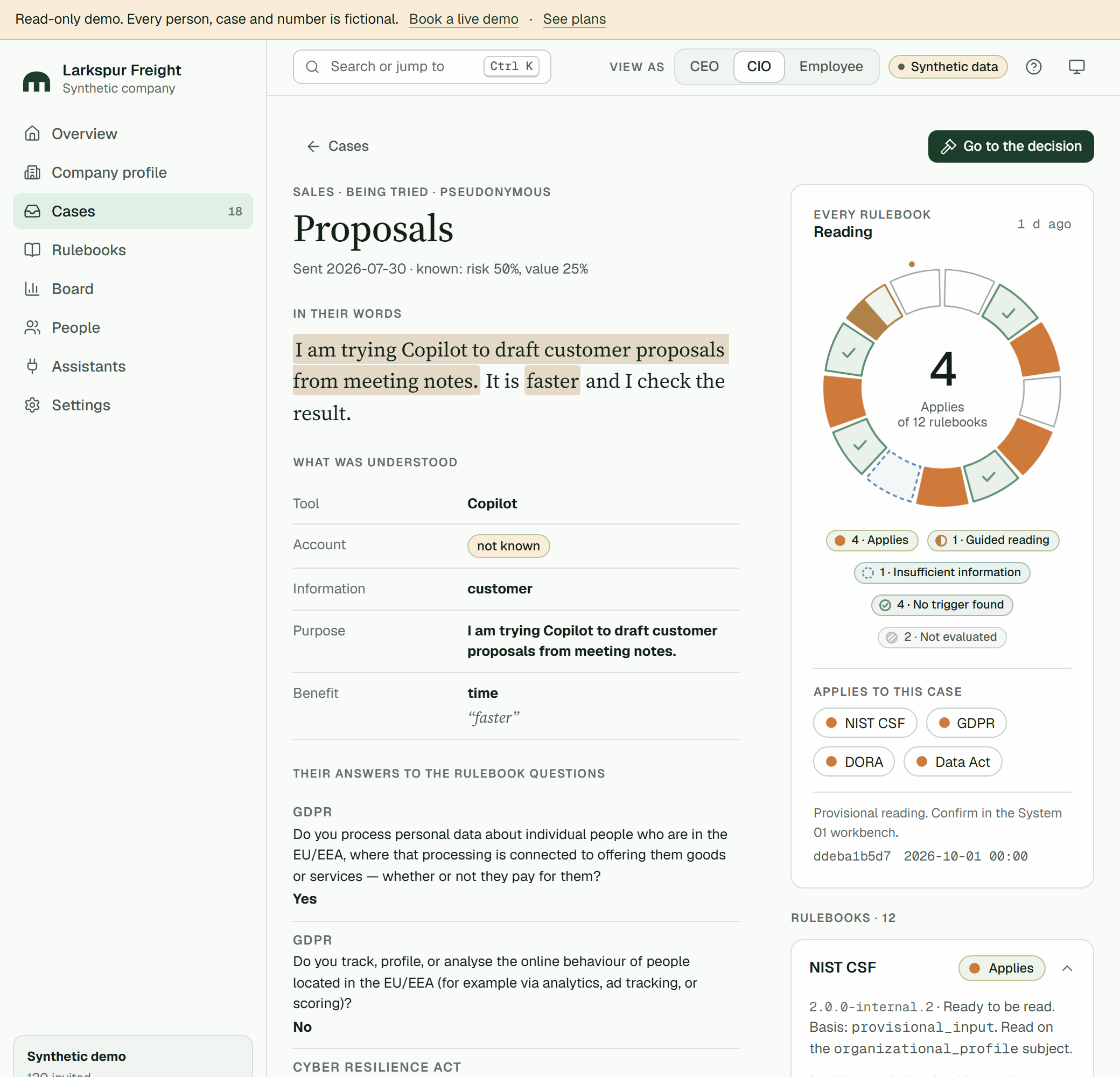
“I am trying Copilot to draft customer proposals from meeting notes. It is faster and I check the result.”
Original wording in the fictional Proposals case.
Facts have a source.
The case names Copilot, customer information and drafting proposals. These facts can be read beside the sentence they came from.
Inspect the original words before relying on the interpretation.
Unknown stays unknown.
The employee does not name an account. The record says “not known”. A reviewer can ask the question instead of mistaking silence for a no.
What answering it unlocks: a more informed review of how the tool is used.
A reading is bounded.
The case separates Applies, Guided reading, Insufficient information, No trigger found and Not evaluated. Those states are not interchangeable.
Selected rulebooks inform the review; they do not decide compliance.
A person makes the call.
The decision form asks for a named reviewer, conditions and a review date. The form in this demo case is empty.
A shown form is not a recorded or approved decision.
Inspect the same case.
Follow the sentence into the actual read-only demonstration. Every company record is fictional.
Open the Proposals case